Tuesday, May 21, 2019

From Peddlers to Department Stores -- Here and Elsewhere

Our local paper here in Atlanta, The Atlanta Journal-Constitution, runs a feature called Deja News (déjà vu, get it?), made up of the headlines and front-page news of prior eras. The entry for May 3, 2019 is on the death on May 2, 1975 of Richard Rich, who had been at the helm of Rich's Department store. The story also makes reference to the trajectory of Sears, Roebuck and Company in Atlanta, and that's what reminded me of something I'd been meaning to write.

In late 2017, when I was researching Atlanta history for my review of the novel Darktown, I came across The Bitter Southerner's history of Sears and its impact on Atlanta and the South. I was reading happily along until I came to the following paragraphs on the boon that Sears and, eventually, other department stores had been for the South. 


In the severe economic depression that followed the Civil War, there were few opportunities for Southerners to make contact with the broader world. The only places to shop were at overpriced general stores that popped up along the rail lines. Here, choices were limited and prices steep. Quite often, farmers found themselves in crippling debt to the general stores, especially after a failed harvest.
Even worse, carpetbaggers, swindlers, peddlers, and snake-oil salesmen preyed upon the desperate region. They took particular advantage of women tending the house while their husbands worked in the fields or elsewhere.


The Bitter Southerner is a modern online publication that advertises itself as above hate, primarily meaning racism, I think, since racism has been America's original sin, but a racism fundamentally defined by skin color. Unawares though the writers and/or publisher may be, that second paragraph caters to another variety of racism, or, if you will, to anti-immigrant hate. Peddlers in America were immigrants and after a certain point were mostly Jews. Anti-peddler sentiment in Europe, where Jews often were condemned to a lifetime of peddling, was of long duration, with names for peddlers such as "hawkers" illustrating the predatory way in which they were seen. The Bitter Southerner characterization suggests the majority culture was peddling -- pun intended -- the same notion: that peddlers -- not yet established nor even of Anglo-Saxon or Northern European descent -- were a threat and danger, especially to wives in the home.

Unbeknownst to themselves, then, if The Bitter Southerner's picture represents accurate historical memory, they are recycling old European prejudices. The language used on the South -- here, I'm referring to "carpetbaggers" -- suggests those prejudices from across the pond were being intermixed with the "lost cause" mentality -- not exactly indicative of liberality and freedom from hate -- but again that claim represents some degree of fixation on white-on-black racism.

I hadn't previously heard anti-immigrant prejudice juxtaposed to the advent of department stores, that is, with department stores seen as representing salvation from peddlers and other unsavory forms of salesmanship. However, the anti-immigrant aspect is not itself unusual.


"Our peaceful rural districts as they are liable to be infested if this Russian exodus of the persecuted Hebrews continues much longer." The Judge, American Humor Magazine, July 8,1882. (Courtesy of the Antisemitic Literature Collection American Jewish Historical Society, New York and Newton Centre, Massachusetts. Located online on May 21, 2019, here. 

When I utilized The Bitter Southerner's "contact us" option, the respondent was not open to my input. I got a brusque response (no longer available to me) that we'd have to agree to disagree.

His argument would likely be that the characterization is based on fact.

In those days nearly everyone -- earlier Jewish immigrants who had already established themselves and people who were part of the Protestant hegemony alike -- thought the incoming Eastern European Jews should take to the land, associating the tendency toward trade and business with unhealthiness. But for the most part farming did not match up with opportunity or with the immigrants' skill set.

Prejudice notwithstanding, peddlers can be seen as representing a wave, not of swindlers and snake-oil salesmen, but of change and modernity -- typically so threatening to established values and mores -- and, not only that, but also the beginnings of empowerment of women and marginalized people.  In America, during the long nineteenth century of immigration to the U.S., many Jewish newcomers began their lives in the New World as peddlers, bringing commerce to far-flung reaches of the country and serving to bring diverse elements of the population into the economy -- newly freed black people, Native Americans, impoverished southerners, westward migrants, miners who otherwise would have been bound to company stores -- everywhere that established commerce had yet to reach. In this way peddling served as outreach, even as Sears, Roebuck and Company later did in a more visible manner. Not only was peddling beneficial to the developing economy, it was also helping to weave the country into a unified whole.

In that connection, see my book review of Hasia Diner's Roads Taken: The Great Jewish Migrations to the New World and the Peddlers Who Forged the Way.    

What began as peddling morphed into trade, as the peddlers not only sold their wares but also traded for scrap and native products such as ginseng, thus contributing to the earliest beginnings of financial emancipation of women. Not only that, but the issuing of small advances or loans by the peddlers became the first small roots of an eventual banking industry. In these ways, peddling contributed to the vertical development of, first, small businesses, and eventually larger industries.

Jews could get jobs in Jewish-run businesses, whereas they could not advance in gentile businesses.

Many a small town had a dry-goods store, colloquially known as the "Jew store." (See my book review of Stella Suberman's The Jew Store.)  Such stores became nodes from which newer immigrants could venture further afield as peddlers, perhaps in the long run to establish a store of their own.

Here's a quote from Melissa Fay Greene's 1996 book The Temple Bombing, relying in part on the words of George Goodwin, "a public relations executive, Pulitzer Prize-winning journalist, and local history buff, born in 1917":

Atlanta after the Civil War was the perfect locale for the mingling of aristocratic southern breeding, taste, and musty old money, with carpetbagger know-how, northern contacts, and new wealth. It was a city with a brick-and-iron heart clanging with trains and fuming with cotton mills, whose far edges softened into miles of green and flowering neighborhoods. "Atlanta welcomed the carpetbaggers," said Goodwin. "Morris Rich [a Temple founder whose little dry-goods store became Rich's Department Store, the largest in the Southeast] was a carpetbagger."

Continuing, from later in the book:

In 1867, Morris Rich opened a little dry-goods store in the ruins of Atlanta. A downpour came on the day he opened; the streets ran like muddy rivers; he laid down planks across the wet red clay to protect the footwear of customers he hoped would come. He offered fifty-cent corsets and twenty-five-cent stockings, and he accepted chickens, eggs, and turnip greens in lieu of money when necessary.

In 1882, M. Rich and Brothers opened up in new, larger quarters with great fanfare and publicity. The Atlanta Constitution hailed the new Rich's as "an emporium of fashion and design ... acknowledged by all who have seen it to be the most complete establishment of its kind in the South, New Orleans, even, not to be excepted." In l906 when the store enlarged again, the Atlanta Journal enthused: "Atlanta's womankind has received a most wonderful New Year's gift."

As we look back, our welcoming of Rich's, Sears, and other department stores may seem inevitable. But it was not.

Eric Goldstein's 2006 book The Price of Whiteness: Jews, Race, and American Identity describes the ambivalence about popular culture and technology that emerged in the late nineteenth and early twentieth centuries, for example, blaming Jews for destroying Christian values for their own enrichment, whether through Hollywood or materialism. But in America the majority population wanted the benefits of culture and commerce. They never overwhelmingly rejected it. (See my book review of The Price of Whiteness here.)

In Germany, the progress from peddler to small dry-goods store to department store was not accepted, judging from the description of Paul Lerner's 2015 book The Consuming Temple, which I have yet to read. In Germany under Nazi influence, the Jewishness at the root of department stores and commercial life (as of peddling) remained the primary focus. There, department stores weren't seen as any kind of gift, but instead as an enticement and a danger to society and to its women.

Whether lauded or condemned, department stores don't represent a break from the earlier primitive-seeming roots of commerce in peddling. Instead, peddling and department stores are points along a continuum.

Don't get me wrong; there could have been bad apples among the peddlers. But they would not have been the ones who succeeded.

Out in the remote parts of the country, a peddler not only had to sell his wares in order to succeed. He also was likely to be dependent on his customers for food and shelter -- for his very survival. He had to have people skills. He needed the empathy to intuit his customers' needs. He was an emissary from parts afar. He could not be an entrepreneur alone but was also a carrier of news, an intermediary, a communicator.



Monday, March 11, 2019

Ammonia

Today I'm recovering from a stomach virus, and my mind turned to a time in my youth when I'd had what we used to call "the flu." It was a gastrointestinal bug with fever. We referred to it as flu, and much later I was surprised to learn that influenza is a respiratory illness, not fever and vomiting.

In 1964 or '65 I was working at Sears, Roebuck & Co. on Ponce de Leon in Atlanta (now Ponce City Market, after a stint as City Hall East), my first full-time job, although I'd also worked there the summers after my Junior and Senior high school years. In the interim I went away to college but returned after one year to work my way through Georgia State College--and marry my boyfriend.

As I said, on the particular occasion I'm remembering, I'd been sick, and sometime during the first day after returning, I felt faint and dizzy. Did I lay my head down on my desk? Or maybe I told my supervisor I didn't feel well.

At any rate, in those days, Sears had a nurse who, as I remember, worked up on the top floor, and I was sent upstairs. I don't know what I expected, but what happened is that I was given a small cup of ammonia, not to sniff (as in smelling salts), but to drink.

This cured my faintness right away. It also cured me of any desire ever to return to see that nurse.

I have thought of this incident a number of times over the years, maybe even when I haven't been sick. Mercifully, in adulthood I've rarely had the stomach flu. I believe it's been ten years since the last time, but it hasn't been ten years since I thought of that ammonia.

Although I've always known immediately what it was that I drank, today I had a senior moment and couldn't say its name. I had to search for cues on the internet and ask my husband what I'd said when telling this story previously. I searched treatments for fainting, but no luck. Then, remembering it had something to do with refrigerants, I was searching under that, until my husband suggested ammonia. Bingo.

Here is the odd part. Although ammonia is used in smelling salts, nothing I could find showed an oral usage, and in fact ammonia is a poison. However, this U.S. National Library of Medicine site says you can be poisoned by breathing it or if you "if you swallow or touch products that contain very large amounts of ammonia." So I couldn't have been given straight ammonia. It packed a punch, though. And that smell!

I've been asking a few nurses I know, but they're only in their sixties and never heard of that usage of ammonia. Then I asked a doctor in the same age group whom I know casually. And he said he doesn't believe me. Just like a doctor. Make that just like a man.

I'm not coming up with anything about oral ammonia for fainting but find it hard to believe Sears had managed to employ some rogue Big Nurse. Hopefully I can trace down this practice, but I'll need to ask some nurses or doctors in their eighties. And from the south.

Sunday, November 18, 2018

Jordan Peterson is Right

I haven't yet read Jordan Peterson, although I heard him in the 2018 Munk debate on political correctness. I also heard about the brouhaha over him and his book for young men, which led me to read up on him. When I say he's right, I'm talking about what he's offering young men, and I'm saying that it's a good thing that someone is providing such advice and encouragement. I'm going to describe the path by which I came to that conclusion--even without reading his book--and then say more about that conclusion.

In the "Nation & World" section of my Sunday paper (The Atlanta Journal-Constitution, November 11, 2018), included in the "In Brief" round-up on p. A21 of the print edition, was the following item:

ISRAEL
Israel backing off its blockade of GazaIsrael has tried to quell Gaza's border protests through force. Now Israelis easing a blockade and allowing millions of dollars in aid to flow into Gaza and to Hamas, which controls the impoverished enclave. The aim, in a plan mediated by Egypt and with money supplied by Qatar, is to provide relief for Gaza, restore calm on the Israeli side of the border, and avert another war. Watching unhappily is the Palestinian Authority, which regards any hint of cooperation between Israel and Hamas as an existential crisis and, many in Israel believe, would welcome a new Gaza war (my italics).

My key point, it should be obvious, is that at any given moment, not everyone wants peace, in the case of Israel-Palestine and more generally. In many cases, not everyone perceives the resolution of conflict as beneficial to their interests. Not only might peace not be in everyone's interests but some may see peace as a veritable threat, or, as per above, as an existential crisis.

Subsequent events--condemnation from Israeli quarters and increased hostilities between Israel and Gaza--prove the point. For example, see this AP report dated November 13, 2018.

As I continued reading my newspaper on that same morning, I came across a review of Stephen King's new novel Elevation. My link is to the entire Ron Charles review as it appears in The Washington Post, whereas the reprinted version in my paper had been whittled to the point of being abridged. Nevertheless, what struck me was that the reviewer picked up on the political incorrectness of Stephen King's having written the good guy in the story as a white male. (Okay, more than a good guy; maybe heaven-bound while still in this life.) Meanwhile, the lesbian couple in the novel are the ones wearing the black hats. Liberals and leftists would cry foul, said the reviewer. In other words, it's not going far enough to say that no thin authors should write about fat characters, no white authors should create black characters, and, maybe, even, no males should give us female characters. No; stories in which a white male provides moral enlightenment while the bad actors are from a suppressed group should not be written, on the grounds of reinforcing our white supremacist culture with its collective foot on the neck of the marginalized.

These two cases, the paralysis in the Israeli/Palestinian situation and the political incorrectness of Stephen King's new book, go beyond accentuating the negative. Instead, what we have is entrenched "us-them" thinking, in which everything bad gets outsourced onto "them," leaving "us" pure and innocent, and also relieved of responsibility. Entrenched narratives have become the foundations on which broad swaths of people stand, such that any change would be unthinkable, would be an earthquake, or, as we hear, an existential crisis. While participants in such dramas invariably insist they want peace and justice, what they demand is for their stories to prevail and with blame borne by the opponents. Anything otherwise would be intolerable.

In his new book, The Road to Unfreedom, Timothy Snyder says those us-them phenomena are "fictions." It is a fiction that the evil of the "other" can remove all the blame and responsibility from one's own side. When we do that, we're writing fiction, not facing reality. The fiction serves a purpose. It also serves as a distraction. Fictionalized problems aren't amenable to solutions.

We're smart and informed, and we know all about these us-them narratives--except that in our own cases we justify our attitudes and behaviors because our opponents "deserve" it. To restate: our narrative comes first and determines the roles we insist others play, allowing us to justify our attitudes and behaviors.

A hated common enemy is so politically useful.

Tell me, please, if we tell only negative stories about "white" people, particularly the males, and confine them in the "bad guy" roles, how is that teaching them to behave well? As the Elevation reviewer says, we on the political left don't think stories in which the privileged and undeserving white guy is the hero should be written. We don't need any more of those stories, we say. Those guys have had more than their share of attention.

However, if we keep them focused on imagining only their evils, why be surprised when some of them turn out to have been imagining being school shooters, country-music festival shooters, church and synagogue shooters...?

So it is that even without reading the Jordan Peterson book 12 Rules for Life: An Antidote to Chaos--and maybe I'll check it out--I saw how much we need it or something like it.

Judge not lest you be judged. Vengeance is mine, saith the Lord. Is it possible those aren't pie-in-the-sky platitudes but, instead, strategies for avoiding the insoluble problems that are our worst nightmares?

Wednesday, October 10, 2018

Guilt: What It Is and What We Should Do about It

I remember "Cheaper by the Dozen," a movie from my childhood (the one from 1950, not the 2003 version). I remember that in that movie there was a child who hid crumbly food in her bed because she had not had enough to eat before she was adopted. More pertinent to my current topic, I also remember something about the father trying to figure out which leg of his pants to put on first. For him, the most efficient way was the essence of "best."

Out of all the things you could do, which of them would be best to do? How should you use your precious time here on earth?

I wrote a book review of Rachel Kadish's novel The Weight of Ink in which I surmised that guilt comes from not doing what one was supposed to be doing. Conversely, guilt can be overcome by doing what one is supposed to be doing, even when doing so entails sacrifice.

I was vague about what people were "supposed to be doing:" something about writing or about pursuing one's own path whether or not one's society approved. (Nice work if you can get it.)

In the spring of 2017, Wilfred M. McClay wrote an essay, "The Strange Persistence of Guilt," followed by David Brooks' March 31, 2017, column of the same name, each of them pointing to the assumption of the victim status as the way people and groups these days attempt to deal with rampant guilt.

McClay had cited Nietzsche's theory that guilt is generated by religion; if so, as religion's grip on society weakened, guilt should have declined. In a similar vein, Brooks cited Alasdair MacIntyre's After Virtue on the breakdown of the moral framework, which, for many thinkers, should have led to moral relativity and more laid-back moral attitudes. Instead, however, the opposite is true; guilt has increased, some say metastasized.

Looking at the build-up of guilt, both McClay and Brooks focus on the lack of societal means of absolution, such as through religion. Nor have Enlightenment mechanisms retained sufficient credibility and power to absolve one of perceived (felt) guilt.

It's at that point that both writers then focus on the assumption of victimhood as the only remaining way of becoming morally blameless. In that scheme, though, guilt doesn't just disappear. That method--assuming the status of victimhood--entails pinning the blame on another individual or a group, an other, where victimhood says 'if it's not my fault, it must be someone else'.' Thus the sequence leads onward toward mob mentality and culture wars--reflecting the pain of feeling "wrong," the desperation to get right, and the human tendency to cope and unify by outsourcing blame onto an "indispensable enemy" (Alexander Saxton, 1975)--all at high cultural cost.

From the first, I thought that Brooks and McClay had it wrong about the central importance of absolution and its supposedly no longer being as available as it had once been. Harking back to societal means of absolution in the past seems off the target. What was really going on in the past? The rule back then was 'a place for everything and everything (and everyone) in its place.'  On the one hand, some were in the right place at the right time, while on other, some were perennially in the wrong place and thus available to serve as scapegoats--or, perhaps, sacrificial lambs. While the lucky belongers undoubtedly did feel the vindication of social approval, not so for the unfortunate others who (within the majority culture, at least) had no approved role to live up to.

What's really different is that back then, in the "good old days," roles, positions, and one's place in society being more nearly secure and fixed, people knew their place and the rules for retaining it. They mostly had little choice in the matter. Post-Enlightenment, those roles were no longer fixed. People could be anything they wanted to be, or so they were told, and they were squarely to blame if they didn't succeed. Of course, that sense of choice applied first to certain males and has only later been expanding.

In his book After Virtue, MacIntyre goes into the matter of roles. If one knows one's role, one knows what one ought to do, that is, the farmer should farm, and the architect should build, and so on. That's how the "ought" gets into the "is;" one is of value if one is doing the job entailed by one's role. Here MacIntyre's conservatism comes into play. Post-Enlightenment, people threw off the shackles of traditional roles and perhaps found out that the freedom to be anything they wanted was not all it was held up to be, while going back to the shackles was not an option either. Alienation and existential crisis could ensue, with the long sought-after freedom just another word for nothing left to lose.

In the midst of such complexity, Brooks' and McClay's nostalgia for old methods of absolution looks to me like wistful idealizing of the past, as though guilt were "just a feeling"--something unconnected to anything real--that in olden days could be magically alleviated and now cannot.

But what is guilt, if it's not "just" a feeling?

Let's say guilt is the liberal democratic version of the external controls as we imagine them in totalitarian societies. Only now, the controls are internal.

Where do guilt, and, for that matter, morality, come from. God? Maybe so, but if so, by way of human societies. It's from our human society that we first learn when we're behaving as we "should" and conversely when we are not. The way we are now requires fewer prying eyes (or did before Twitter, anyway) and relies instead on conscience, that is, on internalized voices from our society. Much of the time it may operate as a smoothly oiled machine of which we're unaware until we violate it. When that happens, guilt ensues, and that's when we know we have consciences. That's when we may anticipate being shunned, or, even worse, punished, usually by ourselves, it seems (assuming we're not sociopaths). But yes, fear is involved. Morality has a power component.

Some of us have stronger and stricter consciences than others--women more than men, minorities more than the majority, and so forth. Think about that hypothesis and what it implies.


Today, we are living in interesting (read unstable, changeable) times. Efforts are afoot to change what's approved of and what is not, or, more accurately, who's approved of and who isn't. Parties who are now held up in some quarters for scapegoating were in the past the ones wearing the mantle of cultural approval and "rightness."

Will there be a societal shift and reversal? Will large swaths of the societal "haves" be transformed into the "have-nots," having accepted that they were undeserving? In other words, will there be revolution (offense being no more "just a feeling" than is guilt)?  For some, that is what would constitute justice. In an emergent cultural story, the former "haves" are under moral duress, and the societal "lasts" are the would-be "firsts."

Some of those who have been nearer the top of the heap--those I'm calling the haves--respond to the moral duress with self-condemnation. They readily cop to having had unfair privilege and accumulating more of society's fruits than they deserve. But I hypothesize that those whose response to being blamed is mea culpa are lacking in intent to become sacrificial lambs. Rather, they will expect their self-blame to bring exoneration, and they will point elsewhere, to an ostensibly more suitable and deserving scapegoat. Hence, not far under their trademark contrition is anger at those who don't see things their way and at the "real" culprit(s).

And that's how the culture wars work: kick the "blame" can down the road: an IED for the future. That is what McClay and Brooks predict: that groups who cannot themselves claim moral blamelessness through victimhood will ally with groups who can and share in targeting an "approved" scapegoat. In fact, the "victimhood" thing could be secondary. It's all about the blaming: an orgy of what Alasdair MacIntyre calls unmasking. Someone must pay.

What's going on is political. Note that power component of morality. Those who find themselves newly blameworthy will be highly selective in how--and onto whom--they deflect the guilt. They will be attuned to whence it came--who had the firepower to assign blame and make it stick and, who, conversely, is the chosen enemy.

Not only did the haves and have-nots of days of yore have fixed roles, but just who was who is in flux. Who were the powerful and who lacked power? On that question and others, history is regularly being rewritten.

Where do our cultural stories that say who is good and who is bad come from?  Who gets to tell the story? Who must pay? Who says? Those are power issues, where power means that people have to listen to the story being told. As power increases, they not only have to listen but also play their assigned parts in that story.

Consider that, since none of us are perfect, anyone can seem deserving of blame. There are so many things we need to be doing, on so many levels, even if we are driving ourselves crazy trying to do them all.

I once read in some novel, I think, about a guy who understood women's insecurities and therefore was able to manipulate them. He knew about the tendency to feel unattractive and so forth, and, feeding the need, could have just about any woman under his thumb. In just the same way, the political actor or social justice warrior who knows no one is perfect--no one can do it all--can find clay feet everywhere and by condemning, conquer, and not only on the individual level, but the group level, too. For example, Newt Gingrich, 1994 and every liberal a "traitor." That's from the political Right--far-right, that is; reactionary. Trump. And from the Left as well: the imperfect government is guilty; all "white" people: at fault, across the board, in a moral calculus by which those who have more of the rights that everyone should have are "privileged."  Jews, whose designated role in most versions puts them on the wrong side plus makes them powerful, so they will deserve what they get.

We know we're supposed to be kind and loving, so we habitually tell these stories to justify our behavior when we're not. Fine print: if violence is permissible, it's permissible everywhere. We think we can control it but can't. I'm talking about treating others, not as one wants to be treated, but how one has been treated (or fears being treated). That is to say, vengeance. That, and becoming what you fight. That's the workings of power (not morality). It is going to divide, not unite, and it is going to backfire, and it will make more harm when it backfires, provoking reaction, which will result in yet more blame. How, instead, does peace spread?

But first: the answer to guilt, which is after all what I set out to unearth, is self-forgiveness. Practice self-forgiveness now and then sufficiently to do what you're here for. Self-forgiveness can't be managed all the time, but some of the time could be enough to do the job you're here to do, think the thoughts you're here to think, say what you're here to say, and follow those ideas. Find those voices from your internalized family that are loving enough and give permission for one moment in time--and maybe then another moment--and another. Like one's conscience, those voices could be from God, if you please, compliments of your internalized society.

We need each individual for the same reason we need each seed and not genetically engineered seeds. If you don't want all the seeds engineered and improved into identical specimens, then don't herd and confine people into mass stereotypes. Discard that story so easy for our human brains, the story with the simplified "other," the story, I mean, that tells you who to blame. At least look at that easy "strong horse" story. Don't be driven.

What am I here for? That's the positive way to ask the question, not whom I'm here to target and out and blame.

Society's going to be controlling, and of course that's not all bad. Not bad at all. We need controls. We can't have people running amok. We need to have some standards and norms. That's okay. But we need a two-way street, a feed-back loop for society, for the world, this thing we're all part of. We need individuals, every last one. Every one of us individuals is needed, to think the things that need to be thought, to have the ideas, to create and to be the change.

Monday, July 10, 2017

Morality, or Strategy?


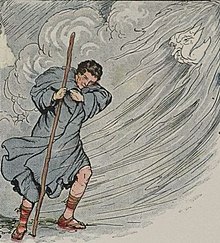
The Wind and the Sun
THE WIND and the Sun were disputing which was the stronger. Suddenly they saw a traveller coming down the road, and the Sun said: “I see a way to decide our dispute. Whichever of us can cause that traveller to take off his cloak shall be regarded as the stronger. You begin.” So the Sun retired behind a cloud, and the Wind began to blow as hard as it could upon the traveller. But the harder he blew the more closely did the traveller wrap his cloak round him, till at last the Wind had to give up in despair. Then the Sun came out and shone in all his glory upon the traveller, who soon found it too hot to walk with his cloak on.
        “KINDNESS EFFECTS MORE THAN SEVERITY.”
---from Æsop's Fables (Sixth Century BCE)
The Harvard Classics.  1909–14.

The top political strategy these days, it seems, is to see someone as doing wrong and denounce him or her.

The wind attempts to strip the traveler of his cloak.
From a 1919 Aesop anthology illustrated by Milo Winter and also included in the Wikipedia page on "The North Wind and the Sun."

Whether anything else beside accusation and blame could be the right course of action goes unasked. For the most part that's what people do--to other people, that is.

Unfortunately when the dust clears those we condemn are still there and still doing whatever it is we have condemned. In fact they often have grown stronger, as though they fed on how they were treated.

But, it is said, evil must be condemned, so we keep on condemning. And, as I said, those so condemned seem to thrive on it. Not only does the condemnation not "take," the behavior thought to be objectionable spreads.

American leftists who hate Israel have been condemning it. Meanwhile, the right wing there has only become stronger while the left is weakened. And now look what has happened over here in America with the election of Donald Trump.

Those Americans who are perennially displeased with American politics, considering the government a criminal enterprise or at least an enterprise being run by the wrong sorts of capitalists, have similarly vented their displeasure, with the apparent result that, with the election, the situation is worse than ever and with the potential to become more so.

Although African-Americans acknowledge having white allies, the rhetoric of race remains mostly binary: those who consider themselves black blame those they deem white and point the finger at "whitelash" as cancelling out progress.

Those are some examples that came to me off the top of my head.

The exception seems to be in the case of a captive audience within limited borders; that's how I'm conceptualizing the situation on some campuses. There, people are cowed, heads down in anticipation of shrapnel from the next impermissible utterance. Even if an exception, though, its applicability may be confined to narrow borders.

But aren't we supposed to confront evil and speak truth to power? Doesn't that define courage? It can certainly feel right, and the Greek chorus of support that so often follows such expression will not detract from that feeling of rightness.

However, if the tactic is making the opponent stronger, something's wrong. To the extent the obvious path of blame and protest isn't working, whether that's the right path needs to be considered.

Maybe we have to decide whether we want to vent or to be the change.  Yet we get locked into the assignment of blame.

I suggest another strategy. Let's call it Judo-ism. Ha--I would come up with that pun!

My analogy is to the martial arts. The strategy is to avoid dissipating one's own strength, while instead turning the opponent's energy in one's favor.

I realize I'm not a student of the martial arts (although at age 29 I did take karate at a nearby Joe Corley studio, attaining the rank of green belt). Nevertheless, please bear with me in this simple analogy.

In fact, bear with me while I try to get down these thoughts that have been percolating in my head.


My focus here involves placing blame on a particular group or people or on a large swath of the population over whom one ultimately lacks control, so that in the end the views and behavior we call unacceptable persist. Or more than persist; we may have fanned the fire.

In the past, before pluralism and before the world grew so small, perhaps the wished-for social control did to a great extent exist.  When one particular group has hegemonic power, their preferred social values and traits can be instilled into the dominant class. Meanwhile the minority is kept on the outs, which really doesn't matter since they are merely the minority.

But now such power is lacking. Polarized segments of society view each other in absolutist terms, thinking of themselves as good and the opponent as without any legitimate concerns, and beyond that, as having nothing positive to contribute. These forces seem stalemated, wreaking havoc on civil discourse while striking out from entrenched positions in hopes of dealing a knock-out blow. To that purpose, anything goes--up to and including turning their invective on the very government that legitimizes all of them and protects their right to speak and be heard. The social fabric is, if not in shreds, worn thin.

What we need to do is to avoid confusing our circumstances with those in which we can deal a knock-out blow.  Look what happened when Japan attacked Pearl Harbor during World War II under that mistaken impression that the US was weak and would be easily constrained. Instead, with one stroke they woke up a sleeping giant, removed our paralyzing internal conflicts, and brought us into the war.

Our polarized forces today hardly look at themselves, focusing solely on the defined enemy.

That's where I think our religious precepts come into play, or should do so. I'm thinking of loving the other as ourselves--which entails thinking of the other as like ourselves--that is, like ourselves in feeling vulnerable, fearing pain and loss, and having similar desires and hopes.

I touched on such ideas soon after the election and was roundly dismissed by the few who ventured to read my reflections as having laudable but naïve and even dangerous sentiments, since one must attack evil, etc., etc.  So, no, I'm not speaking of becoming "nice" and doing whatever Gibbon reputedly thought weakened the Roman Empire. Instead I see the issue as one of strategy, since the modus operandi so obviously does not work, and even, as I've argued, is having an effect opposite to the one desired.

I'm talking strategy. And vision.

Ordinarily, we humans are all too aware of our own weakness and vulnerability but are likely to look on the opponent as a powerful and dangerous monolith against whom anything goes.

We humans are susceptible to the temptation of indulging such a perception, so natural does it appear--and it may in fact be to some degree a natural phenomenon bequeathed to us by our evolution. It's said evolution has made us able to see the faults in others more clearly than those in ourselves, since others can pose an imminent danger that if ignored or overlooked could preclude the possibility of staying alive. From that angle, conscientious self-examination is a luxury best put off until later.

Then, too, the worse we are treating the opponent, the harsher we'll judge them and the darker the light in which we'll see them. As much as we give our judgments as the "reason" for our actions, that kind of judgment follows action, justifying it.

How to wrap our heads around the possibility of that being a short-term view imprisoning us in a zero-sum game, to our mutual sorrow?

In his 2009 book The Evolution of God, Robert Wright argues that in the course of their development, the three Abrahamic faiths each turned to power and force when the facts on the ground permitted it, but when force was not feasible, used precepts more akin to those of the sun in Aesop's "The Wind and the Sun" fable.

The sun persuades the traveler to take off his cloak.
 
What would "the sun's method" signify? Love? Something like recognition that the other, while far from perfect, nevertheless is of value and has something to offer? ...Maybe a lot to offer. The sun's method is sounding something like seeing and understanding the other--superfluous for the wind's method.

According to Wikipedia, "The Wind and the Sun" has been taken not only morally but politically.  Which works better, "severity" or "kindness?" Well, in what situation and to what purpose? Honey draws more flies than vinegar, you might say--assuming we can correctly assess when the situation calls for vinegar and when for honey.

Sometimes one simply lacks the power to squelch the opposition or bend it to one's will.

There have been at least a couple of times I said something so profound and so close to the truth on an online discussion following a book review that I halted in midstream the BS (that's "bad sociology," per James Loewen of Lies My Teacher Told Me fame). I stopped it for around a month, that is. That was as long as the BS could be stopped. There was no power to check it for good and all.

When Deborah Lipstadt prevailed over David Irving after his defamation lawsuit against her on account of her challenging his holocaust denial, was he silenced? No. Not even after the judge handed down the verdict was he silenced; he kept right on spinning. (See the movie Denial.)

Sometimes the balance will finally tip, as with McCarthyism, white-supremacist violence in the Jim Crow American south, or Lost Cause mythology of the Confederacy, but it can be a long time coming before an idea becomes one whose time has come, and in truth we don't know in advance when, or if, that will be. And, truth to tell, we also don't know for sure--although we hope--that it's our own ideas--in part or in toto--that are destined to prevail or should prevail.

But that's ideas. Perhaps there are positive ways in which ideas can be argued, although, truth be told, debate sinks all to quickly into power plays and ad hominem attacks.

Even when it comes to persecution, a little won't stop the entity or movement in question. Arguably, a little persecution spreads the faith. (I attribute that idea to either Bart Ehrman or John Madden in their respective lecture series on early Christianity, but I can't remember which.) Persecution on a wide scale is a different story, but as I said, the groups I'm talking about lack the hegemonic power to suppress the other. I don't much care for the biological analogy but nevertheless will stoop to it here: attempting to suppress a group via disparagement and denigration, but without assuming ultimate power, is like using a weak antibiotic or one not taken for the full course.

Make no mistake: the groups issuing their condemnations are indeed wielding power, notwithstanding that they typically claim to be inveighing against the power of the opponent. That they indeed are wielding power while seeking more of it is not in question, even when we are distracted from noticing.  They may portray themselves as weak and speaking truth to power even as they strive to gain the upper hand.

What's in question is the wisdom--or lack thereof--with which they wield that power.

Moreover, consider that the use of such options are not restricted to one's own group. If one is going to wield the "nuclear option" as one's mode of discourse, one should consider that the opponent may do so, too--and may do so even more effectively.

That's about as far as I can get at this point! To be continued.

Friday, December 16, 2016

My Adventure in Identity Politics

My adventure begins with a group read of two books by my congregation--first, of Ta-Nehisi Coates' Between the World and Me, and, second, of Jim Wallis' America's Original Sin.  It was Fall 2016, and my congregation was confronting the apparent disproportionate shooting of black people in America, particularly black men, by the police.

I say "apparent" since, as Wallis makes clear, we have no statistics.  We do have data on arrests, convictions and incarcerations, but not on police violence. We don't know whether the shootings of black men are what is happening disproportionately or whether we have begun disproportionately noticing the shootings of black men.  Yes, I know what we are seeing, but it takes data to go from appearances to the actuality of what is happening.

Not only are reactions by police subject to unconscious bias, but our perceptions in general are subject to bias. There is confirmation bias: the tendency to interpret new evidence as supporting what we already believe. There is the availability heuristic: a mental shortcut that biases our judgment of a topic's importance based on how easily the topic comes to mind. Another common source of bias is that people's preferences influence what they believe: the so-called affect heuristic. We become convinced of the benefits of the positions we favor, while seeing only the costs of those positions we oppose.  And those are just a few examples.  Not only do we react to what's out there, we create our reality by the act of seeing. We become invested in our vision; the more we see the greater our investment. Polarization happens.

At any rate, we need data to move from story to science, and according to this October 13, 2016 article (from before the election), we're going to get it.

But I'm getting ahead of myself.

Between the World and Me had been excerpted in The Atlantic, a magazine I take. When I heard all the buzz, I picked it up but found it a hard read, all blame and no transcendence, so I put it back down--until, lo and behold, our clergy put it first in the group read on race.

I love books, and Between the World and Me was a far easier read in book form. Moreover, it has the merit of being short. And, since it comes from the gut more than from the head, its logic is not nailed down tight.  Amidst the clichéd harangue against America's "machinery of criminal power," "club of criminal justice," and "criminal irresponsibility" were openings for thought.

Subsequently I've learned you'll be called defensive for comparing yourself to the particular identity group in question: in this case, African-Americans.  Comparisons are a no-no, for although we all have troubles, do not presume to compare yourself to them or appropriate their suffering.

I did get in some thinking, though, and here's my review of Between the World and Me, written before this post on which I'm now working.

With the Jim Wallis book I got doubly bogged down: in white privilege and identity politics. And I thought Ta-Nehisi Coates was hard!  Here's my review of America's Original Sin, which got me thinking and led me to this point.

The main theme of America's Original Sin is reconciliation between white and black Christians.

How do Jews figure in that equation? Are Jews even white? (See the timely article, "Are Jews White," Dec. 5, 2016, The Atlantic.)

In the first half of the last century, the Jewish leaders of the era advocated for authorities to remove the racial designation "Hebrew" from incoming immigrants ("Hebrew," since in those days, "Jew" was a dirty word). Jewish immigrants continued to get that label until the 1950s, when, due to the prevailing cultural and political winds, their advocates succeeded in having it removed. During World War II, erasing boundaries between European peoples and categorizing them as ethnic groups instead of races satisfied the country's need to unify and set us apart from the Nazis. In due time there was the expectation Jews would conform to their new "white" identity; if they didn't, what good would it do?  For more on how that worked, see my review of Melissa Fay Greene's The Temple Bombing.  In essence, then, the social pressures of the day pushed Jews to pass as white, even as most Jews aspired to do just that.  Who would not want to emulate the country's most successful cultural group and, furthermore, avoid persecution? (Seeing all success as suspect leads to a dead end in hope and vision.)

Don't think that you can discern whiteness by skin color alone. White isn't just a skin color but is code for a certain level of society.  For further discussion see my review of Eric Goldstein's The Price of Whiteness.

At the top of the heap in America were the WASPs: white Anglo-Saxon Protestants.  The struggle to erase the distinctions between them and other Europeans--Jews, Catholics, Irish, Italians, etc.--and end their particular power and privilege continued well into the 1960s and beyond. Before that point, college students would not have encountered beaucoup Jewish professors as they do today, since there were fixed quotas as well as restrictions on which fields they could enter. Who knew?  It was in the sixties that I started college, and how was I to know it hadn't always been that way? See my review of John Hollinger's Science, Jews, and Secular Culture.

For a variety of reasons explored by Hollinger, Jews had led that advance upon the ramparts of what Melissa Fay Greene calls the white Protestant power structure.  As we are all too aware, the advances of women, and more to the current point, African Americans, did not come until later, since people of color, especially African Americans and Native Americans, were not yet included with those Americans among whom unity was considered desirable.

If Jews are white--or if they have passed as white--do they need to atone?

Here's how the story goes: white privilege accrued to those admitted into the ranks of whiteness. If everyone thinks you're white, you've had certain advantages and avoided certain disadvantages, at the expense of people who were not designated as white. According to that narrative, if you were so designated, it's up to you to atone. And atonement entails having sinned.

Added to that is that standing up for the black community is what American Jews do. It's our basic historic version of social justice.  So, that's the direction in which a lot of our clergy are leading us.

But for Jews, in a sense, it's been there, done that.  This is not to knock what we did during the civil rights era.  We did good--some of us, certainly not all--and some of us paid the price, too.  This time around (at least before the election), though, it has not been dangerous, but popular. This time, we were not leading but getting on the bandwagon.  We were establishing our bona fides with white Christian groups while simultaneously declaring our membership in the "white race."

I understand that Jews want to stand up for black people, not only in general but often for our own partners or children or for ourselves--but this time around, I think the ones we were taking the most care of were ourselves. There was a certain incoherence to our actions.

Historically, Jews in America have tended to stand up for themselves vicariously by standing up for others--African Americans in particular--on the basis that if we support the inclusion of all we'll be supporting inclusion for ourselves as well.

That vicariousness is something I've turned over and over in my thinking.  Above and beyond black and white in America, Jews have long inhabited a bad-guy role in Western civilization due to the cultural dominance of Christianity.  To a certain degree it's to be expected that we would have inhabited that role: we live in the same culture and we're pickled in it like everyone else. At this point I've come to associate our vicarious self-advocacy with the vaunted "Jewish guilt" incurred from that longtime assigned role. Hence the difficulty that Jews, who also happen to be a small group, have had in standing up for ourselves more directly within American society.

If  power is the ability to make people not only listen to a cultural story but also to play the role decreed for them in that story, then, practically speaking, we Jews have had little choice in our symbolic value for the culture as a whole.  Adding atonement to the picture further complicates it.

The privilege Jews have received from being white has been ambiguous, that is, mixed, as one might expect upon reading The Atlantic article on whether or not Jews are white.  Jews have had considerable cultural success.  But, on the one hand, viewed from the political right, Jews aren't truly white but have infiltrated society by passing as such (a not uncommon view among the Protestant intellectual leadership up until the mid-twentieth century).  On the other hand, for the left, now that being white is not so good, Jews are the essence of whiteness. Jews retain their identification with capitalism and with a degree of success that can seem unfair, so are sometimes assigned a disproportionate share of guilt for their presumed white privilege.

Even if Jews are white and whiteness is something for which to atone, proclaiming one's purported whiteness in order to atone can come off like a backhand assertion of status and group membership, given Jewish racial ambiguity: I'm white and you're not. It can feel paternalistic.

This sin-and-atonement model assumes that everyone did the same thing with their skin color, that is, use it for fun and profit at the expense of people of color. Not so!  Even as it has not been right for black people to be stereotyped--so that each individual is stamped with the alleged faults of the whole--neither is it right to mark all people from another group based on supposed group characteristics.

Jews may have something to learn from the interracial experience.  I recently heard author Mat Johnson's NPR interview on his new book Loving Day.  Here also is my review of his graphic novel Incognegro, featuring courageous light-skinned interracial men who went South undercover during the Jim Crow era to spotlight the practice of lynching.

Saying that the racial designation of Jews can be ambiguous is not saying Jews are black. There are more things in heaven and earth than black and white.  Nor am I claiming we're interracial--although there are not enough ancestors to go around, and at some level we're all mixed.

Note that ethnicity is not the only issue with respect to belonging. Are you smart enough to belong? Economically secure enough? Slim enough? Sociable enough? From the right side of the tracks, the right family, the right community, the right denomination?  Who is acceptable enough? Let's say society demands we all shape up and keep in line--but let's save that extended discussion for later.

Now I want to raise the question of where the storied Jewish brain power is in regard to all these questions of race, identity, belonging, and atonement.  As far as I can tell, for example, none of the clergy leadership has thought to look very closely at what was coming out around the edges of the Black Lives movement (as they commonly were doing vis-à-vis the Trump campaign), nor did they consider the movement's roots in or relationship to Black Power, and the implications. Of the rabbis I know who have taken up the atonement model with its witnessing and listening--that is, being an ally in the sense of deferring to the experience of  those who are people of color and as such are deemed the only experts concerning their own experiences--none examined, through its broader application or otherwise, that model which has so recently emerged from college campuses.

Being submissive and subordinate--not having a voice--is the result of being compressed into a role in the narrative of the dominant social group.

It's not the case that societal demands require constant overt enforcement, since people internalize them.

Despite some overlap, a role in a powerful group's story never comprises the totality or essence of who the other group is.  That's true of Jews in the Christian imagination. It's true for people who have been considered black, in the white imagination.  And it's also just as true for people who have been considered white, in the black imagination.

It took power to suppress black people. And it's a power play to attempt to compress some white-looking people into a people who, to redress the historical imbalance, believe justice now consists of telling particular black people only what they want to hear, while self-righteously scolding other insufficiently subservient white-looking people.

Everyone's voice is needed.  Everyone gets feedback. There's a time to speak and a time to listen.

I spent most of my life thinking I had a deal here in America: I was supposed to "behave." I didn't know that meant squelching myself into the requisite identity.  I didn't know I was responding to powerful societal messages by passing; I thought I was just behaving, doing what I was supposed to do.

For Ta-Nehisi Coates, the issue was "the American Dream," and he learned at an early age it wasn't meant for him. For me it was e pluribus unum. Not until an advanced age did I zone in on my sense of precarious inclusion. Why did it take me so long? I lived in suburban surroundings that were nothing if not genteel. I wasn't being called names or getting beat up on the way home from school, but there were things nobody could talk about. My mother, mistaking her hopes for fact, told me "all that" was over and done with except from the ignorant or stupid. So, I could not read my social situation correctly. When I picked up on confusing vibes, I thought it was me.   As long as that was the case, I could not question--couldn't really see--my automatic assumptions. At the point I gained enough perspective to see them, the deal was off: the deal that meant I had to remain blind to what it means to see or even think about society's demands.


So, as I said earlier, it's complicated. Who is guilty? Who is to atone? Are they atoning for themselves, or are they being put into the role of atoning for others as well? And, if the latter, in whose story is it that they find themselves playing that guilty role?

Abraham Joshua Heschel said, "Few are guilty, but all are responsible."

Assigning guilt is very close to blame.  What would it look like if we were to focus instead on taking responsibility?


Wednesday, February 10, 2016

The Trouble with Codewords and Keeping Your Mouth Shut

As an  American Jew, I have long wondered why there are areas related to Judaism or Jewishness that I can't talk about, or at least it feels as though they are not supposed to be talked about.  I've been wondering that for about a decade now--as long as I've been able to think about such things--although I certainly felt it long before I could think about it.  Recently my reading has inspired me to think more systematically about one particular area: that of violence toward Jews.  Before I delve into the specifics of my thinking on that subject, though, I'll go into two background areas, one from which I drew relatively more inspiration, and the other a relatively minor, but still significant, contributor to my endeavor.

Background Analysis--The Jim Crow Era

 I was inspired by a book, an older book: Melissa Fay Greene's The Temple Bombing, from 1996, which I've recently read as part of a group study.  My inspiration came from the author's examination of how it happened that that bombing, which happened in 1958, provoked or, at least, preceded change in attitudes toward civil rights in 1950s Atlanta. 

Beforehand, moderates ducked the issue, white supremacists held sway, and the old segregationist way maintained its homeostasis, in spite of the Supreme Court's landmark 1954 decision in Brown v. Board of Education of Topeka. There may as well have been no contradiction at all between segregation and what was good and moral.  Afterward, the contradiction stood out in high relief.

Here are some of the highlights:

Before the bombing, Atlantans thought of their city as a bastion of moderation and modernity.  As far as they were concerned, racial hatred didn't exist, at least not here. If you said it did, you were thought to be creating division, not pointing it out.  After the bombing, Atlantans had to admit it did exist. 

In retrospect, preaching about the problem by the rabbi of The Temple was seen as having lured out the racial hatred and exposed it.

In the new view, young men committing violence out of misguided racial solidarity were not, after all, showing their mettle in defense of the system but revealing themselves as dangerous extremists.

The following excerpt from the book contains a quotation from Mayor William Hartsfield in the October 13, 1958, issue of the Atlanta Constitution:


"Looking at this terrible demolition I cannot help but realize it is the end result and payoff of a lot of rabble-rousing in the South.  Whether they like it or not, every political rabble-rouser is the godfather of these cross-burners and dynamiters who sneak about in the dark and give a bad name to the South.  It is high time that decent people in the South rise up and take charge."

...The mayor's statement was a rallying cry, an attempt to reach the vast proportion who wrongly believed that their silence on the race question was an adequate, even moral response.

Before the bombing, ordinary Atlantans could rationalize their resistance to integration, as though the words of liberalizing newspaper columnists and preachers pointed to an abstraction. They seemed to stand transfixed and paralyzed in the vain belief they could keep to their same old ways.


...(M)oderate people, people of quiet goodwill, civilized people could sidestep it all, as if the race question itself were not quite worthy of their notice, as if the subject of Negro rights was somehow slightly obscene.  

After the bombing, people couldn't linger on the sidelines.  They had to decide whether they were for or against violence as a means of perpetuating the status quo. Now they could see what the choice of anarchy entailed.  In the light of a new day, ordinary, everyday people for the first time began to stand up and speak out on these issues.

Let's say that most power structures, once in existence, strive to maintain themselves.  Once established, most power structures--all the way from Stieg Larsson's spooky fictional counterintelligence unit in The Girl Who Kicked the Hornets' Nest to the beneficiaries of favoritism within ordinary families--don't call themselves out of existence and go quietly into that dark night.   And maybe the likelihood of violence goes up when that system comes under threat.  Melissa Fay Greene says that the violence at the fringes as Jim Crow came up against the pressure for civil rights served to maintain the white Protestant power structure of the day.

During the Jim Crow period in the American South, the treatment of black people both demonstrated and maintained their lesser status.  As such they existed outside the full protection of the law.  The system enjoined upon them to "stay in their place"--not that that held any guarantees.  Illogical and unpredictable events and all too predictable punitive reactions alike served to keep them in that place and maintain the system.

Other people, too--Jews and Catholics, for example--made their way as best they could in the society of the day.  They served at the pleasure, on one level protected by their white skin but also expected to kowtow to the system to keep it in place and keep their place in it.  Dependent on the system, they experienced social pressure to make obeisance to established social codes.  The conventional response was to keep one's head down and under the line of fire.  There was pressure on insiders and outsiders alike to march in time and in lockstep.  

Such is society: it gives us that without which we social animals cannot live, but at a price.  Change, too, comes at a price.

What penalty did dissenters fear? In a sense what they feared was shunning, that they, too, like people of color, would be placed outside the protection of the law and at the mercy of its self-styled defenders.  Awaiting dissenters was a string of accusations to which Jews were particularly prone, that they were radicals, communists, nigger-lovers, plotters against the Southern way of life.  They would be foreigners among us--outsiders whose designation as such would justify plucking them from the safe haven of legal protection and throwing them upon the tender mercies of vigilantes (or turning a blind eye when that happened).  Heretofore there had been numerous southerners in general and Jews in particular toeing the line and striving to fit in (although that was no guarantee).

After the bombing, though, and after some critical mass had been reached, such that right and wrong finally were illuminated,


"...there came yet another noise, one not heard much of late, one often drowned out.  It was the still quiet voice of the moderate heard once again in the Southland" (Pat Waters, Atlanta Journal, October 24, 1958, as quoted in The Temple Bombing).

There were those who spoke up, finally, and there was the flood of financial contributions, despite that The Temple was insured. And there were the well-wishers.  In this instance, then, that congregation of Jews was not shunned or cut off, but instead was sheltered within the circle of big downtown houses of worship, as one of them, and given soothing reassurance and comfort. In the meantime, segregationist leaders, who, as Melissa Fay Greene puts it, had been sanctioning resistance and violence out of one side of their mouths, had to scramble to deplore such acts out of the other side of their mouths, allowing liberal leaders to seize the moral high ground. 

As liberal columnist Ralph McGill wrote (Atlanta Constitution, October 13, 1958; quoted in The Temple Bombing),

Let us face the facts.  This is a harvest.  It is the crop of things sown. 
It is the harvest of defiance of courts and the encouragement of citizens to defy law on the part of many southern politicians....
It is not possible to preach lawlessness and restrict it.  
To be sure, none said go bomb a Jewish temple....
But let it be understood when leadership in high places in any degree fails to support constituted authority, it opens the gates to all those who wish to take the law into their own hands....
....
This, too, is a harvest of those so-called Christian ministers who have chosen to preach hate instead of compassion.  Let them now find pious words and raise their hands in deploring the bombing of a synagogue.
You do not preach and encourage hatred for the Negro and hope to restrict it to that field.  It is an old, old story.  It is one repeated over and over again in history.  When the wolves of hate are loosed on one people, then no one is safe.
------------------------------

Background Analysis--Krugman versus Charen on Republican Presidential Politics

On December 14, 2015, my local newspaper reprinted a matched set of editorials--one left-leaning and one right-leaning--that reminded me of what I'd just been reading in The Temple Bombing.

The first was by Paul Krugman, and the second by Mona Charen.  The topic was the ubiquitous Donald Trump and his pursuit of the Republican presidential nomination.

Krugman holds that mainstream Republican effort to exploit the racist and xenophobic fears and prejudice of their right-wing base, while simultaneously tamping down reaction and maintaining at least a semblance of control, has heretofore been conducted through innuendo and codewords.  Donald Trump has merely said out loud what the party establishment has been whispering.  Trump has ripped away the veil.

So along comes Donald Trump, saying bluntly the things establishment candidates try to convey in coded, deniable hints, and sounding as if he really means them. And he shoots to the top of the polls. Shocking, yes, but hardly surprising.

If Trump has destroyed Republican establishment camouflage, Charen and others are at pains to restore it.  The problem, they insist, is Trump, who is putting them in a bad light, and not the underlying pattern his words have highlighted.

This week, while we were still burying our dead from San Bernardino, every Republican — rather than explaining why President Obama's refusal to fight the war on terror has led to this moment — instead had to condemn Donald Trump's mindless proposal to keep every single Muslim out of the United States until further notice. Again, he's the perfect bogeyman.

It’s not just that what he says demands condemnation. It’s that it seems to give credence to the Democrats’ narrative.

But can what has once been seen be unseen?  Like the other way of seeing a reversible image, you cannot unknow that it is there.

The Charen article also tries to cover up that conservatives, too, have public intellectuals and elites who are shaping their view--Charen herself, for instance.  Republicans would like to have us think that conservatives somehow maintain a special degree of independence from such forces in order that they might "think for themselves."

Trump, of course, has nothing to offer except personality    — even if its charm eludes me. But his emphasis on “getting the best people” is exactly wrong. That’s the progressive idea — that the best people know better how to run your life than you do. That’s what we’ve had under Obama.

As during the Jim Crow era, there are vested interests in maintaining the illusion of a simpler world, one in which we knew who were the good guys and who were the bad, and one in which the good guys were people "like us."  In this connection see Mike Luckovich's August, 26, 2015, cartoon of  Trump wearing a "Make America White Again" cap.

Whatever your political leanings, my focus here is still on the question of how whatever is right in front of our noses can be, for all intents and purposes, invisible, and in how we maintain that blindness, thus denying responsibility for consequences, adopting, in other words, a "hear no evil, see no evil" posture, even as we sustain the animosity-generating illusion. And, further, I'm interested in how such illusions can collapse, as Paul Krugman claims is happening under Trump's spoken-out-loud hate speech--and as happened in my hometown after The Temple bombing.

----------------------------

Codewords and Silence on the Subject of Violence Against Jews

At present we're in an era where many people consider violence against Jews understandable--dare I even say justifiable?--because of Israel, or so it is said.  I explored that narrative in a previous post.  Internationally, terrorism against Jews gets little attention unless in the context of terrorism against others.

What I was reading in The Temple Bombing on the Jim Crow era in 1950s Atlanta made me think of this current situation vis-à-vis Jews.  In the present day, there's this relative silence when violence or injustice against Jews occurs--except perhaps among Jews, and I'm one of those who has begun speaking out; once I had noticed this pattern, words seemed preferable to befuddled disbelief. Anyway, when Jews come to harm, people mostly shake their heads and avert their eyes.  As Melissa Fay Greene writes on the subject of race relations in the Jim Crow South, it's as though it would be slightly obscene to mention Jews, much less speak up for them.

In 2014, swastikas were painted on the Jewish fraternity house at Emory University. The response was officially supportive, but the student newspaper's report included a complaint (not shared elsewhere) that the incident had received a disproportionate amount of attention.   I wondered whether the complainer's real issue was that it had received any attention at all.

The issue here is not competition over victimization.  I am wondering about the seeming imposition of silence on the subject of violence toward Jews or denigration of them.

In another incident, five years ago now, I was online with friends from a liberal Methodist church I'd been attending with my husband as news broke on the attempted assassination of Congresswoman Gabrielle Giffords.   At the time, there had been ongoing criticism of the graphically violent Republican campaign language such as Sarah Palin's placing a target over the Congresswoman's district.  "Words matter" had been a constant refrain.  Then it came out that Giffords was Jewish, and, suddenly, silence ensued on the subject of words mattering. It seems her attacker had to be viewed as completely crazy, his actions thus rendered meaningless.

The Emory swastika was "classic" antisemitism, in other words, a Nazi-style slur.  I thought maybe that was why it required attention.  But ordinarily, violence against Jews is not considered big news here in the U.S..  By that I mean it doesn't seem to make the national news.  For instance, we all saw those Westboro Baptist Church signs denigrating gays, but broadcasting the Jew-hating posters they were also brandishing did not happen and seemed to be a no-no.

Most antisemitic acts if aired at all seem to be buried in the local news.  Unless such incidents are reported in a Jewish news source or posted online, I'd not be likely to hear of them at all.

We in this country--including Jews--would like to deny that there is antisemitism here, or so it seems. Conventional ideas are that Jews are liked here, safe here; in fact, as one sometimes hears, Jews are "privileged." We assume others have taken their place on the receiving end of hate.  Yet, although thankfully rare, most religious violence in this country occurs against Jews.  Most hate crimes in America are racial, but when it comes to religious violence Jews are the most common target.

It's confusing, and one reason may be that, Anti-Defamation League or no, anti-Judaism is so thoroughly interwoven with the culture.  Sometimes it's hard to tell when anti-Jewish attitudes end and ordinary church begins, given negative preaching and scriptural passages read free of accompanying educational material.  One small example to give an idea of what I'm talking about is the passage about hiding behind locked doors "for fear of the Jews" (John 20:19), read around Easter time. (I mention that one, having had occasion to waggle a finger quietly to signal it's too late; I'm already inside.)  I'm not talking about egregious antisemitism but about ordinary church.  I hypothesize that the overlap between anti-Jewish attitudes and normative values enhances an attitude of denial.

In some leftist circles here, including some liberal Christian and Unitarian circles, the idea that the U.S. has been too receptive to Jews is conducive to what I call Holocaust, not denial, but minimization.  It happened, but it's over, so the story goes, and Jews are using guilt over the Holocaust to deflect condemnation of Israel.

Israel!  People do talk about Israel; in the public square we are allowed to talk and argue about Israel.

Beyond that, the veil of silence falls and we enter the arena of innuendo.  Jews in France are murdered.  They aren't Israeli, but somehow, for more and more people, the subject of Israel makes the violence make sense, makes it reasonable, makes it, if not exactly okay, something they can understand and to which they could, under some circumstances, even subscribe.  The fact it happens to other Jews (Israelis being used as though synonymous with Jews) may be unfortunate but is understandable.  And, since understandable, not a big story, not news.  Not a subject of concern.

With Israel as the cover story, those telling that story have their excuses: "It's Israel.  We're just criticizing Israel.  Israel causes antisemitism."

But rationalizing, even tolerating violence, then using words to camouflage it--that's plausible deniability.

Just as, around the turn of the twentieth century, the racial pseudoscience of the day gave the disenfranchising of Jews its scientific gloss, the cover story of Israel disguises the focus on Jews as being a social justice issue about Israel.  The effect is arguably a narrative in which Jews are, for some people, back in their place as "the other," and without a word of it spoken. 

I'm arguing that there is a purposeful silence on the issue of violence toward or denigration of Jews, analogous to the silence Melissa Fay Greene says prevailed regarding race relations in the Jim Crow South.

If that's the case, we would expect energy expended to maintain the silence, that is, to keep the lid on, as Paul Krugman delineated regarding Republican political strategy.  And there are such efforts.

First may come an accusation of over-sensitivity, "Jewish paranoia," or the like; to say, in other words, "You're exaggerating" or "You're just imagining things," and thus to deflect comment--a dynamic similar to telling black people that voicing their concerns amounts to "playing the race card." "It's all your problem," in other words.

If deflection fails, one might hear ever-bolder condemnation of Israel, with any effort to widen the outlook portrayed as an opportunistic diversion from the matter at hand, Israel.

Continued failure to fall into line can result in the charge of a blatant deficit of empathy for Palestinians.

Then may come the accusation of conflating Jews with Israel, all the while the accuser is doing just that: the best defense is a good offense in which one accuse the other party of doing what you yourself are doing.

And the volume increases.  At all costs, keep the focus on Israel and off of the accuser.  Distraction is the name of the game, and, loud though it may be, it functions to maintain the silence.

This is the system maintaining itself.

Melissa Fay Greene also wrote that the dynamic of silence and tolerating violence at the fringes of society served the prevailing white Protestant power structure.  Does the silence regarding Jews, and the pattern of looking the other way and rationalizing violence against them, have a corresponding function?  What "power structure" would that serve?

Here are two columns from 2010 that say, no, the traditional power structure is not seeking to maintain itself.  Both articles appeared on the heels of the appointment of Justices Sotomayor and Kagan to the U.S. Supreme Court, leaving a Court devoid of Protestants.  Max Fisher wonders whether Jews are the new WASPs.  And Noah Feldman goes so far as to hypothesize that WASPs are phasing themselves out.

Is that what has happened?  Do groups willingly divest themselves of power?  That's not the picture we would expect to see.

In a mainline liberal Protestant Sunday school class, after the last two appointees gave us the Court we have now, a friend made what was for me a memorable slip of her tongue: she referred to a Supreme Court without any Christians.  She was neither magnanimous nor pleased.

Those two articles from 2010 allude to something else that has transpired over the last sixty or seventy years, something other than the emergence of the state of Israel yet something that has emerged during the same time frame: economic competition for the positions that Protestants could previously take for granted.  Prior to that time, the universities and professions and the airwaves and the ranks of public intellectuals--and the Supreme Court--weren't full of Jews as they are at present.

We should not underestimate the impact of economic competition.

Lastly, Paul Krugman in his column pointed to the political aims of silence. According to him in his discussion of Republican presidential politics, Trump's playing openly on fears and prejudices is confounding the Republican establishment's plausible deniability. Trump outed the dynamic of targeting immigrants, people of color, and Muslims in particular as "other," as common enemy.

Correspondingly, the political aim regarding Jews could be to use them as the common enemy.  When times are difficult, there's nothing like a common enemy to build your base and rally people to your cause.  Moreover, this has been a traditional role for Jews, and, in fact, one in particular that can't be said out loud.  A cover story is needed.


As it used to be rationalized, violence against "Negroes" was understandable or to be expected.  It was "normal."  You might say the story implied they required special measures.  What else could you expect?  For a very long time such special measures weren't news, either.

But can violence be targeted exclusively toward those you may not like or approve of?  Is hate divisible?  Or, might the earlier quotation apply again in the present day?

"...It is an old, old story.  It is one repeated over and over again in history.  When the wolves of hate are loosed on one people, then no one is safe."

Talking about what can't be talked about isn't easy, but I decided it's worth trying. I don't want it to be said, "...they came for the Jews, and I did not speak out..."

----------------------------


Readers have reported difficulty with commenting on my blog. You should be able to leave a comment if you log in via Google.  But in any case, copy your comment before trying to post it, so whatever happens it won't be lost.